
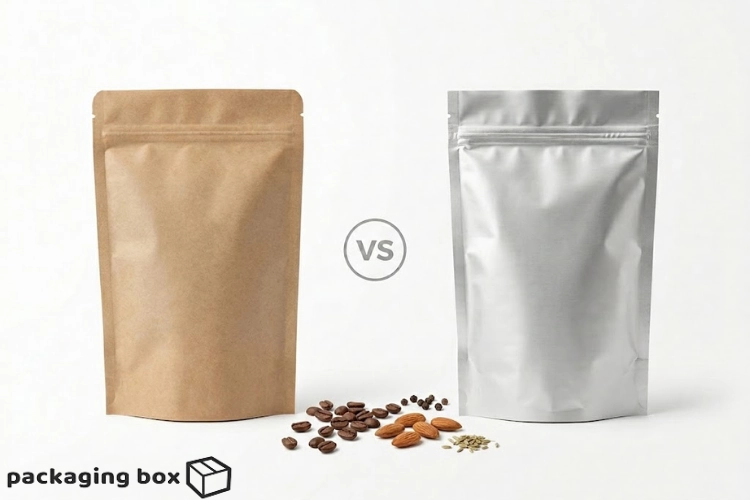

Picture a coffee roaster who packs fresh beans in a good-looking brown kraft pouch. The shelf looks great for two weeks. By week six, customers say the coffee tastes flat. Nothing was wrong with the beans. The pouch let in oxygen and moisture. The aluminum pouch vs kraft pouch question is rarely about looks. It is about how long your product stays safe, crisp, aromatic and sellable.
In this guide we compare both pouch types on barrier strength, real-world shelf life, cost, sustainability and best-fit products. By the end, you will know which one suits your business, and why the answer is sometimes a hybrid.
🧪 Why Shelf Life Depends on the Pouch, Not Just the Product
Food rarely spoils on its own schedule. It spoils when the environment around it changes. Packaging is the only wall between your product and that environment.
Four things shorten shelf life. Oxygen triggers oxidation, which turns oils rancid and fades flavor. Moisture ingress makes snacks soggy, powders clump, and mold grow. Light, especially UV, breaks down vitamins, colors and fats. Odor and aroma loss quietly kills the experience, even when the food is technically still safe.
A pouch with strong barrier properties slows all four. A pouch with weak barriers lets them in. This is why shelf life extension starts with choosing the right material, before any preservative or recipe change.
If you are new to the format, our beginner’s guide to stand-up pouches covers the basics before you go deeper here.
🧱 How Each Pouch Is Built
The names are misleading. Most “kraft pouches” are not pure paper, and most “aluminum pouches” are not solid metal. Both are laminated pouches made of stacked layers.
🟤 What Is a Kraft Stand-Up Pouch?
A kraft stand-up pouch has an outer layer of kraft paper, which gives the natural, earthy look. Inside, there is usually a thin plastic liner, often PE, so the pouch can be heat-sealed and hold food. Many come with a resealable zipper and an optional clear window.
That plastic liner matters. Paper alone is porous. It breathes and absorbs humidity. A standard kraft pouch with only a PE lining blocks some moisture but little oxygen. It also blocks almost no light unless the paper is thick and dark.
You can browse this style in our kraft stand-up pouches collection.
⚪ What Is an Aluminum Foil Pouch?
An aluminum foil stand-up pouch is built on a thin layer of real aluminum foil, often sandwiched in a PET/AL/PE laminate. PET gives printability and strength, AL gives the near-total barrier, and PE gives the heat-seal layer.
Some cheaper “silver” pouches use VMPET (metalized film) instead. This is plastic film with a microscopically thin aluminum coating. It looks like foil and blocks much more than plain plastic, but it is not as airtight as true foil.
Our guide to aluminium foil stand-up pouches explains the common structures in more detail.
🟫 The Hybrid: Kraft Paper Lined With Foil
This is the option many brands overlook. A kraft paper lined with foil pouch keeps the natural paper look outside and adds an aluminum layer inside. It combines the appeal of kraft with the protection of foil, and it is one of the best answers when buyers want both. See our kraft paper aluminum lamination pouches.
📊 Barrier Performance: The Numbers That Matter
Packaging engineers measure protection with two key metrics. Oxygen transmission rate (OTR) tells you how much oxygen passes through the material. Water vapor transmission rate (WVTR) tells you how much moisture gets through. Lower is better for both.
The table below uses typical, approximate values. Real results vary by thickness, supplier and seal quality, so treat the figures as a guide and not a guarantee.
| Pouch Type | Oxygen Barrier | Moisture Barrier | Light Protection | Typical Shelf Life (Dry Goods) |
|---|---|---|---|---|
| Plain kraft + PE liner | Low | Low to moderate | Low | 1–4 months |
| Kraft + VMPET liner | Moderate | Moderate to good | Good | 6–9 months |
| Kraft + aluminum foil lamination | High | High | Excellent | 9–18 months |
| Full aluminum foil (PET/AL/PE) | Very high | Very high | Complete | 12–24 months |
The table shows a clear ranking for protection. Full aluminum foil leads, a foil-lined kraft pouch comes close, and plain kraft sits at the bottom. The ranges are wide because product type, filling method and storage conditions all matter.
⏳ Shelf Life Showdown: Which Pouch Lasts Longer?
If you came here asking which pouch has longer shelf life, the short answer is aluminum. Foil is one of the strongest barrier materials used in food packaging. It blocks oxygen, water vapor and light almost completely.
🥇 Aluminum Pouch Shelf Life
With true foil in the laminate, a well-sealed pouch can protect dry foods for 12 to 24 months. Add an oxygen absorber or nitrogen flushing and some products last even longer. That makes the aluminum pouch shelf life ideal for long-term food storage and shelf-stable packaging.
🥈 Kraft Pouch Shelf Life
The kraft pouch shelf life depends heavily on what is inside the paper. A basic kraft pouch with a PE liner suits products you sell fast, usually within a few months. A kraft pouch with a foil lining can compete with full foil for many everyday foods.
So when someone asks, “Which pouch lasts longer, aluminum or kraft?” the honest answer is that aluminum wins on raw protection. Kraft wins on look and feel, and a foil-lined kraft pouch narrows the gap.
🍪 Practical Examples: What Happens in the Real World
Numbers are useful, but examples stick. Here is how each pouch behaves with common products.
☕ Coffee Packaging
Coffee is the harshest test. Roasted beans release CO₂ and start losing aroma within days of roasting. For coffee packaging, oxygen and light are the enemies, so foil is the clear winner. A black or dark foil pouch with a one-way degassing valve can hold flavor for months. Plain kraft will let aromatics escape and staling begin much sooner. Our black stand-up pouches with valve are built for exactly this job. The same logic answers “Which packaging is best for coffee freshness?”
🌶️ Spices and Herbs Packaging
Spices lose color and pungency when exposed to light and air. For spices and herbs packaging, foil-lined or full aluminum pouches hold their strength far longer. A plain kraft pouch can work for a small batch that sells in a few weeks, especially if the spice is already dried and stable.
🥜 Snacks, Nuts and Dry Fruits
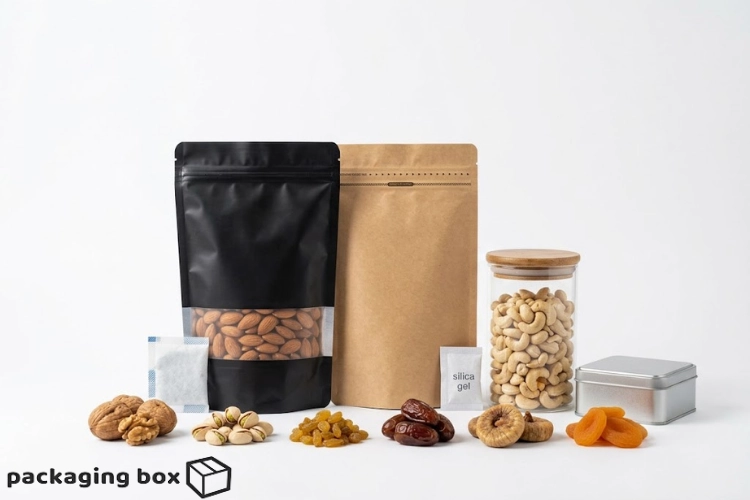
Nuts contain oils that go rancid, and chips go stale the moment moisture arrives. For snacks and nuts packaging and dry fruits packaging, a foil-lined kraft pouch is a smart compromise. It protects the fats and crunch while keeping the handcrafted, natural look shoppers love. For gift-ready dry fruit lines, premium laminated pouches also look far better than basic bags.
🍵 Tea Packaging
Tea absorbs odors like a sponge and fades under light. Tea packaging needs high aroma retention, so choose foil or foil-lined kraft. Plain kraft will let tea pick up outside smells and lose its character.
🥤 Protein Powder, Supplements and Pet Food
Fine powders attract humidity, which causes clumping and spoilage. For protein powder packaging and powdered supplements packaging, aluminum is the safest choice, especially in humid climates. For pet food packaging, fats and aroma matter, so foil-lined pouches again perform best. If you are unsure whether your product suits a pouch at all, read what foods you can store in a stand-up pouch.
🔄 Kraft Pouch vs Mylar Pouch: Clearing the Confusion
Mylar is simply a brand name for a type of polyester film (PET). In practice, “mylar bags” usually means metalized or foil-laminated pouches. So the kraft pouch vs mylar pouch comparison is really kraft paper against a foil-style barrier bag.
Mylar bags give excellent oxygen, moisture and light-blocking packaging performance. They are popular for long-term food storage. Kraft pouches give a premium natural look but need a foil or VMPET layer to match that protection. If your priority is the longest possible freshness, mylar-style foil wins. If your priority is shelf appeal with solid protection, a foil-lined kraft pouch is the balanced pick.
⚖️ Pros and Cons: Side-by-Side
This table summarizes the kraft vs aluminum packaging comparison so you can decide quickly.
| Factor | Kraft Pouch | Aluminum Pouch |
|---|---|---|
| Barrier strength | Low (plain) to high (foil-lined) | Very high |
| Shelf life | Short to medium | Medium to long |
| Look and feel | Natural, artisan, earthy | Sleek, modern, premium |
| Light protection | Limited unless foil-lined | Complete |
| Puncture resistance | Good | Good to excellent |
| Eco appeal | Strong perception | Weaker perception |
| Cost | Usually lower | Usually moderate to higher |
The pattern is simple. Aluminum is the performance choice, kraft is the brand-personality choice, and a hybrid sits between them.
✅ Pros and Cons of Kraft Pouches
Kraft pouches look warm and authentic, and they suit artisan brands. They are often cheaper and print well for custom printed pouches. The drawback is weaker barriers when unlined. They are not automatically airtight, and humidity can enter through the paper and the seams.
✅ Pros and Cons of Aluminum Pouches
Aluminum pouches offer outstanding oxygen barrier packaging and moisture barrier packaging. They protect product freshness for a long time and resist light completely. The drawbacks are a less natural look and a harder recycling story, since multilayer foil laminates are tricky to separate.
🌱 Durability vs Sustainability: The Real Trade-Off
Many buyers want eco-friendly packaging and long shelf life at once. Those goals can pull in opposite directions.
A pouch that extends shelf life prevents product spoilage, and wasted food is itself an environmental cost. A fully recyclable pouch that lets food spoil in two months may do more harm than good. So when asking “Are aluminum pouches eco-friendly?” the fair answer is that they are not the greenest material, but they can reduce food waste.
Kraft looks greener, and paper does carry a strong sustainability image. But a kraft pouch with a plastic liner is not simply a biodegradable pouch. Unless the structure is certified compostable or designed for recyclable packaging, claim it carefully. Overstating green credentials can hurt trust and may break advertising rules in some markets.
A practical tip: match the pouch to the product’s real needs. Use maximum barrier only where the product demands it. For a broader look at responsible choices, see our guide to eco-friendly custom packaging.
💰 Cost Comparison of Pouch Packaging
The cost comparison of pouch packaging is not just the price per piece. Look at the cost per sellable unit.
A cheaper pouch that lets product go stale creates returns, bad reviews and write-offs. A slightly pricier foil pouch that keeps goods fresh for a year can cost less overall. Order size, print method, zipper and valve options, and custom sizing all affect pricing. If you plan to scale, our bulk packaging order guide explains how minimum quantities influence cost.
🧭 How to Choose the Right Pouch for Your Product
Use these quick checks when choosing the right pouch for your product:
- Product sensitivity: Oils, aroma and fine powders need high barriers.
- Sales speed: If stock sells within weeks, plain kraft may be enough.
- Storage conditions: Humid or hot warehouses call for foil.
- Brand image: Natural and handmade brands lean kraft, while premium or technical brands often lean foil or black laminates.
Then think about format. A heat-sealable pouch gives a firmer seal than a simple fold-over, and a resealable zipper pouch helps customers keep the product fresh after opening. Do not forget size either. Our stand-up pouch size guide helps match volume to weight, since over-sized pouches trap extra air.
Finally, make sure the material is food-grade packaging. Check that the supplier can confirm food-contact safety, because food safety should never be traded away for looks. Our article on how to choose food packaging in Pakistan covers what to verify before ordering.
⭐ Our Recommendation by Business Type
Here is a simple way to decide.
For coffee, tea, spices, protein powders and supplements, go with aluminum or a dark foil laminate. For cookies, granola, nuts and dry fruits with moderate turnover, choose a foil-lined kraft pouch such as our white kraft aluminium laminated stand-up pouches. For fast-selling bakery or local products, standard kraft pouches can do the job and keep costs low. For liquids, sauces and ready meals, a heat-resistant retort pouch is the right structure.
If you want a ready-to-order hybrid, take a look at this kraft paper with aluminum lamination pouch. For pure foil, see our aluminium foil stand-up pouch. You can also explore the full pouch category to compare colors, windows and sizes.
🛡️ Tips to Get the Longest Shelf Life From Any Pouch
Even the best pouch fails with poor handling. Follow these habits to protect freshness:
- Fill in a dry, clean environment and seal fully, with no product caught in the seal.
- Remove excess air before sealing, or use an oxygen absorber where suitable.
- Test your seals and run a small shelf-life trial before a big launch.
- Store finished stock away from heat, sunlight and damp floors.
A good pouch combined with good process gives you the real benefit. Packaging is a system, not a single material.
❓ Frequently Asked Questions
Which pouch lasts longer, aluminum or kraft?
Aluminum lasts longer. Its foil layer blocks oxygen, moisture and light almost completely. A kraft pouch can come close only when it includes a foil or high-barrier lining.
Is kraft paper good for long-term food storage?
Plain kraft is not ideal for long-term storage because paper is porous. It works for short-term sales. For longer storage, choose a kraft pouch with aluminum lamination.
Are kraft pouches airtight?
A kraft pouch with a heat-sealed zipper and lining is fairly airtight against casual air exchange. It still allows slow oxygen and moisture transfer unless it has a true barrier layer.
Is a kraft pouch with a foil lining better?
For shelf life, yes. It protects far better than unlined kraft and keeps the natural look. It is a strong middle option between style and protection.
How long does food last in an aluminum foil pouch?
Dry foods can often last 12 to 24 months when properly sealed, and longer with oxygen absorbers. Results depend on the product, moisture level and storage conditions.
Can kraft pouches block moisture and oxygen?
Only partially. Unlined kraft offers limited protection, while kraft with a VMPET or aluminum layer blocks much more.
🏁 Final Verdict: Aluminum Pouch vs Kraft Pouch
In the aluminum pouch vs kraft pouch debate, aluminum gives the longest shelf life, kraft gives the warmest brand story, and a foil-lined kraft pouch gives you most of both. Choose by product sensitivity, how fast you sell, and the image you want on the shelf. When in doubt, test a small batch before committing to a large order.
📞 Ready to Pack Smarter?
Whether you need foil pouches for coffee, kraft pouches for cookies, or a hybrid for dry fruits, PackagingBox.pk can supply custom-sized, food-grade options for your brand. Browse our full pouch range or explore our food packaging solutions and place your order today.




💬 0 Comments
Leave a Comment